When a Pitted Concrete Driveway Can Be Overlaid Instead of Replaced
A rough, crumbling surface is often a skin-deep problem, and the slab underneath may be worth keeping.
October 13, 2026 · 3 min read
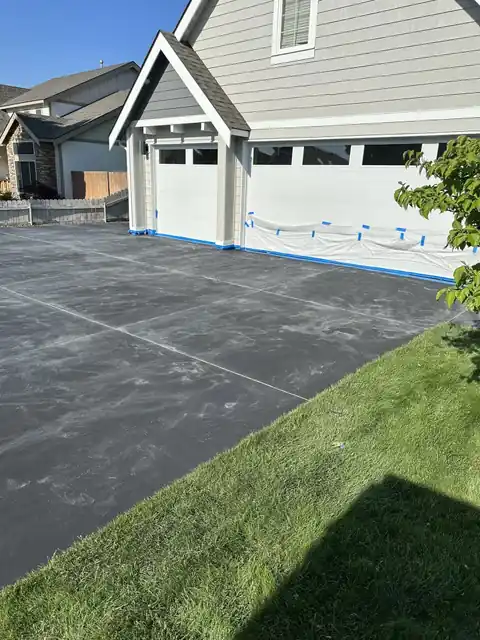
A driveway that's pitted, flaking and rough can feel like a verdict: rip it out and start over. Sometimes that's the right call. A lot of the time it isn't. When the slab underneath is sound, a concrete overlay can give you a new surface without the demolition, the hauling and the weeks of a torn-up yard.
The trick is knowing which situation you're in. Here's how to tell.
What pitting actually is
Pitting and scaling are surface problems. The top layer of the concrete breaks down, leaving small craters, flaky patches and a rough texture that catches on shoes and holds water. Eastern Washington winters are hard on exposed concrete because of freeze-thaw. Water works into the surface, freezes, expands and thaws again, and de-icers on the driveway make that cycle harder on the top layer.
Age plays a part too, and so does the original pour. A surface that was finished too wet or sealed poorly will break down sooner than one that was done carefully. None of that tells you much about what's happening deeper in the slab. Often the answer is: not much.
Signs an overlay is a good fit
An overlay is a thin cementitious layer spread across the old surface. It bonds to what's there, so the old slab needs to be a decent foundation. These are the signs that point toward an overlay:
- The slab is solid, with no sections that rock, sink or sound hollow.
- The damage is mostly surface pitting, flaking or a rough texture.
- Cracks are narrow and stable, not wide and still moving.
- Water runs off the driveway and doesn't pool against the garage or house.
- You want the driveway to look better, not just stop crumbling.
That last one matters. Because an overlay is a finished surface, it can be stamped or textured in a pattern. Craig's photos include driveways finished in a dark stamped plank look, which is something a plain patch job can't give you.
Signs you should replace instead
An overlay follows what's underneath it. If the slab has heaved, sunk or tilted, the new surface will follow the same shape. If cracks are wide and one side sits higher than the other, that movement is likely to show up again. If the concrete is crumbling through its full depth, or water is getting under the slab and washing out the base, a surface layer is just a cover-up.
A good installer will tell you this up front, even when it means a smaller job. Hearing that the slab needs to come out is better than paying to cover a problem that returns in a year or two.
How an overlay goes down
The work starts with the damaged areas. Deep pits and broken edges get patched so the overlay has a sound base. The surface is cleaned and prepared so the new layer can bond. Then the overlay is spread across the whole slab, not just the bad spots, so the finished driveway reads as one continuous surface.
Edges get taped before the overlay goes on, wherever the driveway meets siding, lawn or the garage door, so the lines stay crisp. Craig's photos show that taped edging along lawns and house walls. Once the overlay is down it's finished in the chosen pattern or texture and sealed.
Because it's built up in layers, an overlay job takes more care than it looks like from the street. Weather, surface temperature and drying all matter, which is another reason to hire someone who does the work by hand instead of rushing through it.
Looking after it afterward
A resurfaced driveway isn't maintenance free, but the upkeep is simple. Keep the sealer in good shape and re-seal when the surface starts to look dull or worn. Go easy on harsh de-icers, since the same salts that pitted the old surface can dull the new one. A plastic-edged shovel is kinder than a bare metal blade. Rinse off salt and grit when the weather lets you.
Small chips and dings are easier to deal with early than after a winter of water getting into them. If you notice a spot lifting, deal with it before the next freeze.
Craig's Concrete Overlay for Pitting Concrete Driveways page shows finished driveways and what the work involves. If yours is pitted and you're not sure whether it's a candidate, book a consultation at (509) 492-8403 and Craig can look at the slab with you.
Columbia River Coatings, (509) 492-8403
Call (509) 492-8403More articles
Metallic, Flake or Solid Color: Choosing an Epoxy Garage Floor Finish
Three finishes sit on the same prepared slab, and each one behaves differently once you start living with it.
What Happens to a Slab Before Epoxy Goes Down: Cracks, Patches and Prep
Most of an epoxy job happens before any color is mixed, and the slab decides how the finished floor holds up.