Concrete overlays
Concrete Hardwood Overlay
A concrete overlay finished in a wood-plank pattern, for rooms, porches and slabs that should not look like bare concrete.
Chapter 01
Bare concrete looks unfinished, and real wood does not belong on a slab
Plain concrete in a living room, an entry or a covered porch tends to read as unfinished, however sound the slab is. Real hardwood is the obvious answer until you remember what a slab does. It holds and passes moisture, and boards laid over it cup, swell and lift. Porches and slab-on-grade rooms are exactly where that happens, so the wood look is better made out of the concrete itself.
A concrete hardwood overlay is the other route. The slab you already have becomes the floor, finished to look like boards instead of being covered up with them.
Craig McConathy lays these in Pasco and across the Columbia Basin, for rooms, porches and slabs that should not look like bare concrete. A job can be a single room or a whole run of living space, and the consultation is where Craig looks at the slab and the light before anything is quoted or scheduled.
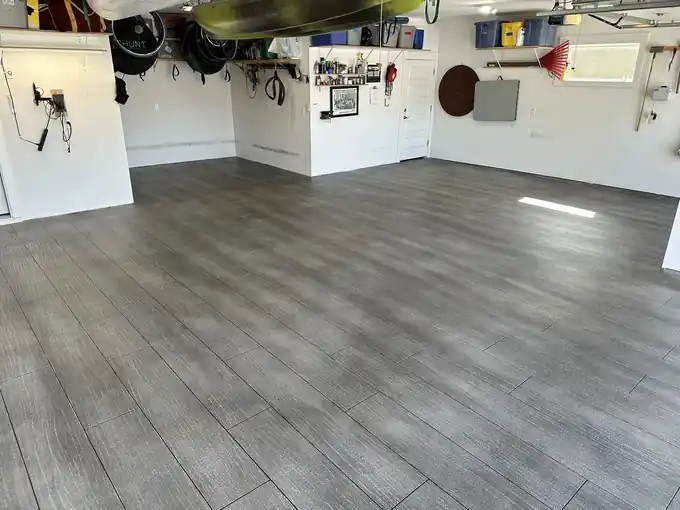
Grey wood-plank pattern concrete overlay across a garage floor
A cementitious overlay first, then boards cut and stained into it
The work begins with the existing slab. Cracks and low spots are repaired, the surface is cleaned and prepared, and a cementitious overlay is laid across it so there is one sound, even surface to work on. That preparation is the unglamorous part of the job, and it decides how the finished floor looks and how long it lasts.
The plank pattern is made in that surface. Board edges are laid out, grain is worked in, and grout lines are cut so the floor reads as individual planks. The stain goes in as part of the finish, which is why each board carries its own variation of tone instead of one flat color. A real plank floor never has two identical boards, so neither does this one.
The photos below show a dark plank living space, a close view of brown boards with pale grout lines, and a stamped plank porch. Each one was tuned to its room, and Craig does every step himself, from the first consultation to the final coat.
Chapter 03
No boards to swell: living with a plank-pattern floor
There are no boards to swell, gap or cup, because there are no boards. The surface is sealed, so it wipes clean with a damp mop, and it sits happily in places where real wood would not. Sweep it, damp-mop it, and wipe up spills when they happen.
Pick the stain tone with the room's light in mind. Dark brown planks feel warm in a bright room with big windows and can feel heavy in a small one, while a lighter tone opens a room up. Craig talks it through at the consultation and looks at the slab at the same time.
To book that consultation, call Craig on (509) 492-8403. He is a licensed, bonded and insured Washington contractor, licence COLUMRC781K6, working out of Pasco.
Laid by Craig McConathy, owner and installer. Licensed, bonded and insured, WA #COLUMRC781K6.
Boards that are really concrete
Every floor here is concrete with the plank look worked into it. For the same overlay on exterior concrete, see the driveway overlays, or compare it with a metallic epoxy floor for an interior slab. Learn more about Craig, or send a note about your room.
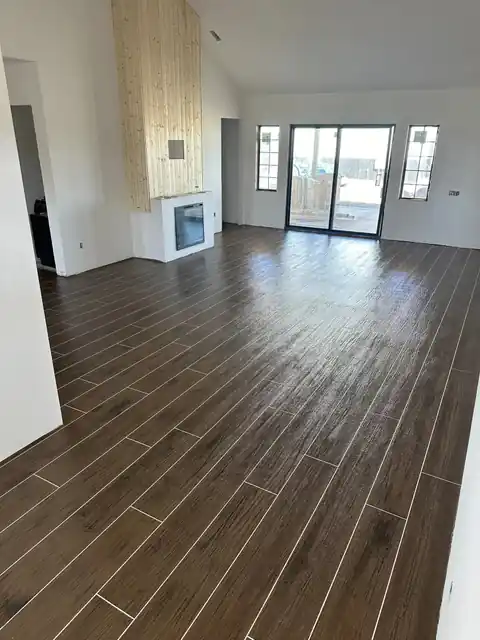
Dark brown planks running through an open living room toward the sliding glass doors.
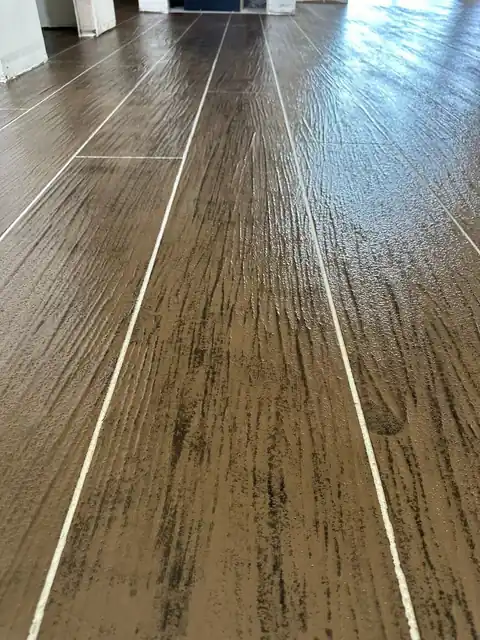
Brown boards with pale grout lines and dark grain marks, seen up close.
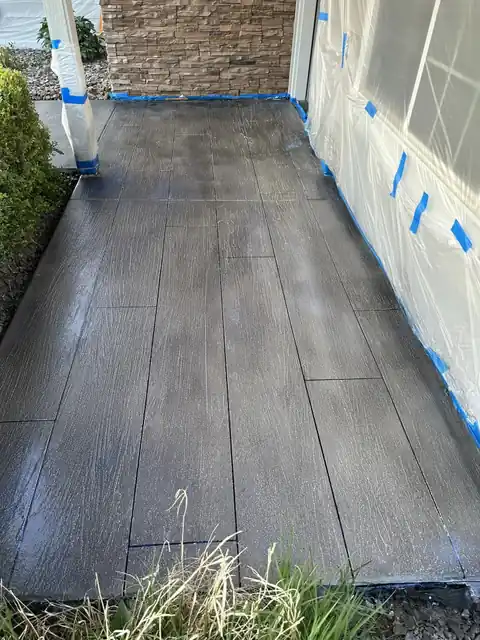
A stamped plank porch with the edges still taped off against the stone and siding.